| Bob
Penoyer |
|
|
|
|
|
|
|
|
|
| October
1968 to October 1969 |
|
|
|
|
|
|
|
|
|
| Some
of the Sights of Korat, Bangkok, and Pi Mai |
|
|
|
|
|
|
|
|
|
|
During
the early part of my time at Korat, we were on a work schedule of
two 12-hour shifts per day, six days per week. This was a holdover
from the Tet Offensive that began in Vietnam in February 1968. This
heavy schedule made visits to town a top priority. It also made
going to town with friends difficult.
Because
everyone worked six days per week but everyone's day off was different,
it was sometimes hard to get to town with friends. When someone
had the next day off, he'd always want to blow off steam in town
that night. Those who wanted to go to town with him had to sacrifice
some sleep in order to be on duty the next morning. But a lot of
us did it because going to town was a top priority.
The
pictures shown here are a mixture of a lot of different phases of
life away from the air base. They are presented in no particular
order.
|
|
|
 |
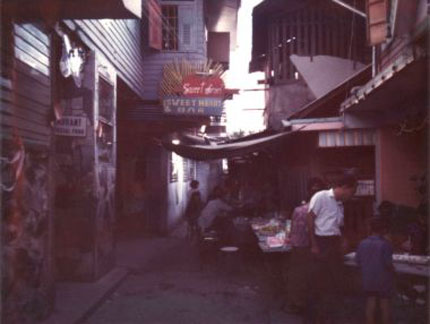
This
very confined area was known as Nitnoi Alley, Sweetheart
Alley, and Darling Alley. It was the busiest area in
Korat at night.
Nitnoi
Alley was a very narrow pathway that provided access to several
bars. It also provided access to Bar Row, which is at the far end
of the narrow opening seen near the center of the picture.
The
Sweetheart bar can be seen at the left with a bar girl standing
in the doorway. The Darling bar is the window at the top left. The
term "nitnoi" means "small" or "tiny"
in Thai. The "alley" is very small. Hence the name.
|
|
|
|
|
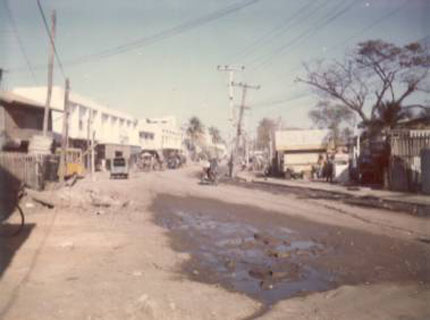
This
is the infamous Bar Row. Particular bars cannot be seen in this
view but there were several along this road.
The
water seen in the road was constantly seeping to the surface until
the road was paved. Incidentally, most of the paving work, and most
of the construction work in general, is done by women!
|
 |
|
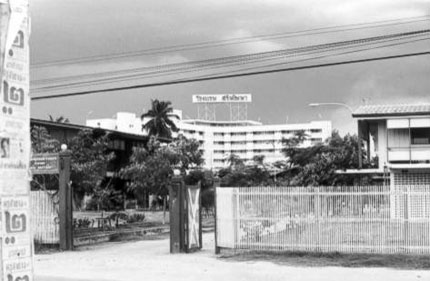
| The
Sripatana Hotel can be seen in the distance. It was located near Bar
Row. The Sripatana was one of two rather modern, Western-style hotels
in Korat. It was one of the few places in Korat where air-conditioning,
decent food, and comfortable rooms could be found. When the next day
was a day off from duty, it was a nice place to sleep while getting
away from the oppressive heat of Thailand. |
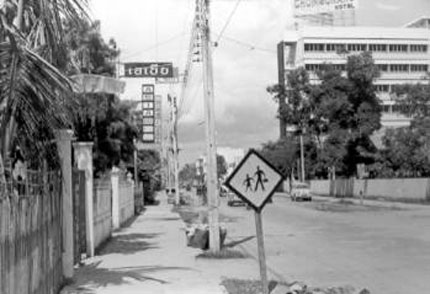
The
large building at the right is the Chomsurang Hotel. The Chomsurang
was somewhat nicer than the Sripatana and had better food, but it
was a fair distance from Bar Row. Also, the Asia Massage can be identified
by the sign above the sidewalk. Massage parlors were popular among
the Americans. |
 |
 |
|
 |
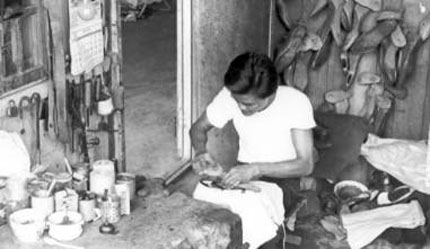
This
is a cobbler that I stumbled on one day while wandering through town.
I've always liked this photograph, so I've posted it here. Unfortunately,
without the crisp detail that can be seen in the original photograph,
it loses some of its character. Still, I like it. |
|
|
|
|
|
|
|
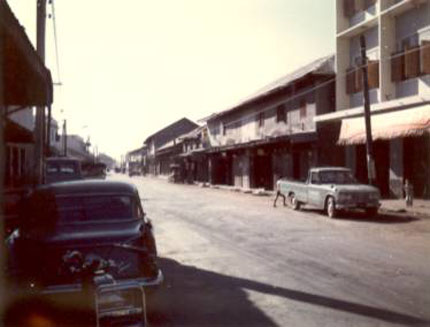
| This
is a long, lonesome, dark stretch of road at night. It runs
from Bar Row in the distance to the downtown area behind the camera.
The total distance is maybe 1 mile. Imagine walking this unlighted
road alone at night! |
 |
|
 |
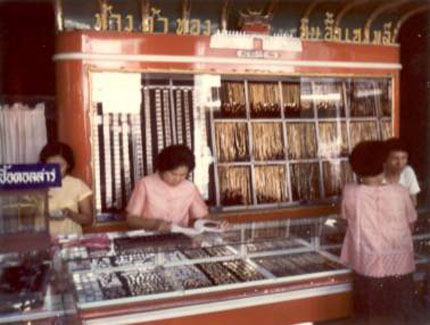
Gold
stores were very common in Thailand. The gold jewelry was 24kt.
The
prices were very realistic. For example, if you bought a gold necklace
for $100, the store would buy it back later for $97.
|
|
|
|
|
|
|
|
 |
This
is one of several marketplaces in Korat. These large, open-air markets
sell all sorts of fresh food. Notice the samlors (pedicabs) parked
along the street. |
|
|
|
|
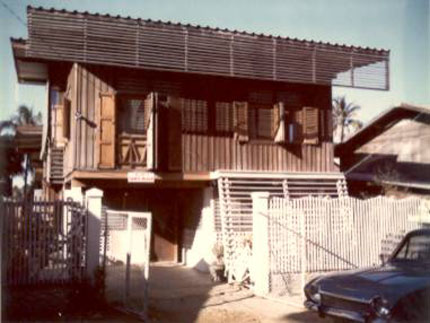
Sam's
Place
This
was a great place for steaks! The story I heard about it
was that Sam was either a soldier or airman stationed in Thailand.
He married a Thai woman. When he left the service, he stayed in
Thailand and opened this restaurant. The prices were very reasonable.
For example, the most expensive steak cost 70 baht ($3.50) and was
so large that it spilled over the edges of the plate. The steaks
were tender and tasted great.
|
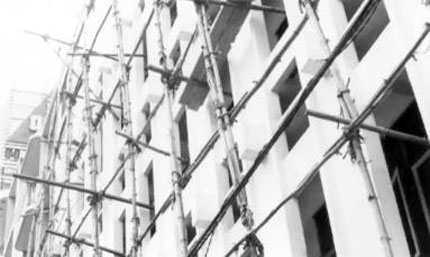
Thai
Scaffolding
This
amazingly crude assemblage of bamboo lashed together formed the
standard scaffolding used in construction in Korat. As mentioned
before, women seemed to do most of the work at construction sites.
|
 |
 |
|
|
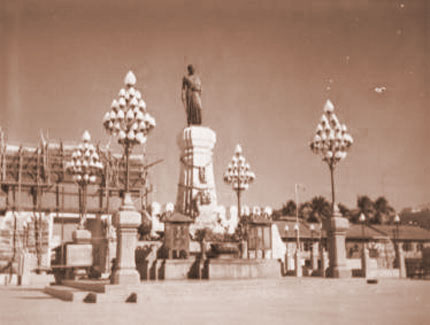
Yahmoh
This
statue of a woman is located in the square at the center of the
downtown area. It was explained to me that Yahmoh is "like
Buddha." It was never clear what this meant. However, the statue
appeared to be treated with great reverence. Often robes and other
clothing were placed on the figure. (I have since found out that
the woman depicted by the statue was named Thao Suraneree
though the people of Korat often call her Khun Ying Mo. Click
image for more info.)
|
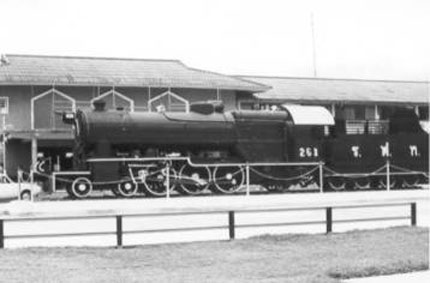
Train
Station
This
steam engine is located in front of Korat's train station. There
was a surprising number of steam engines in use as switching engines
at the station.
|
 |
 |
|
|
|
|
|
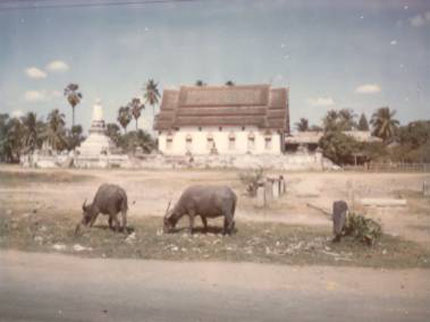
| Water
buffalo are grazing near an abandoned Buddhist waht (temple.) |
 |
|
Me,
Malee's brother, and Malee

Malee's
mother and Malee

|
These are pictures of my hootch girl, Malee, at a time when she
wasn't working on base. She had invited me to go to a Buddhist
festival. This was quite an honor because only a half-dozen
or so airmen had been invited. Unlike her picture on the On
Base page, here she is an example of the reason why Thailand
is called the Land of Smiles.
The
half-dozen or so airmen and maybe 40 Thais took buses to a Buddhist
sanctuary, away from Korat. The buses stopped outside of town. There,
everyone left the buses and the Thais began parading and dancing
through town to a Buddhist sanctuary.
The
airmen were treated as honored guests. When we were trying to take
pictures of the parading dancers, the whole procession stopped
until we were done! Upon arriving at the sanctuary, the oldest
(and, therefore, the most respected) woman in the group sat the
airmen at wooden benches formed in a circle. She passed out bottles
of soda pop to us all, then invited us to dance a traditional Thai
dance with her in the middle of the circle, one at a time. It was
clear that we were embarrassed to attempt the unusual motions of
the dance in front of everyone, but we all laughed and had a great
time.
We
then went into a large two- or three-story teak building where everyone
ate chicken (which appeared to be sliced haphazardly through
the bones) and drank rice beer. Rice beer looks like milky water
with a few pieces of rice floating in it, but it tastes like beer.
The
whole event was a lot of fun, one that I will never forget. One
of the best parts was experiencing such wonderful treatment from
the Thai people.
|
|
|
Floating
Marketplace
Bangkok
These
are just two pictures from Bangkok's famous Floating
Marketplace. People come here like any other marketplace to
buy and sell foods, fabrics, and other goods. But here, of course,
everything is done on boats. The marketplace is a branch off of
the Chao Praya River.
|

 |
|
|
Waht
Po
Bangkok
|
|
|
Waht
Po is a very large Buddhist temple located in Bangkok along the
shore of the Chao Praya River. Each year the king visits Waht Po,
arriving on one of his extravagant barges. The pointed towers seen
here are among many at Waht Po. These are pagodas and hold the remains
of previous Thai kings.
|
|
|
Waht
Po
Bangkok
|
This
is perhaps the most peculiar sight at Waht Po. I will tell you
about it as a guide explained it to me.
What
you see here is a phallic symbol carved in stone. As I recall,
it was about four feet tall and maybe one foot across. It sits
on a rocklike platform, some of which can be seen in this photograph.
I
was told by my guide that barren women would come here and sit
on this figure while praying to Buddha. If the woman later conceived
a child, she returned and placed a piece of gold leaf at the top.
The pieces of gold leaf seen here appear to attest to some measure
of success for the ritual.
If
you are unfamiliar with gold leaf, it is a small square of pure
gold, maybe 3/4-inch square and only molecules thick. It is often
used to give building domes and roofs, statuary, and other items
a bright gold appearance. A piece of gold leaf is very delicate
and must be handled with the greatest care to prevent it from
disintegrating. Guides and others often hand out pieces of gold
leaf to visitors. The gold leaf is held in a fold of paper.
|
|
For
more pictures of Korat, click the image  |
|
Come
along to a Buddhist festival by clicking the image
 |
|
For
more images of Waht Po and to see the king's royal barges,
click the image  |
|
For
more images of the Floating Marketplace, click the image
 |
|
Pay
a visit to Thailand's Pi Mai Sanctuary by clicking the image
 |
|
To
access the On Base pages, click the image  |
|
|
|
|
|
|
|
|
|
|
|
To
link to another Korat Web site with a lot of interesting pictures,
click
here.
To
link to a Korat Web site with some great maps and aerial photographs,
click
here.
|
|
|
|
|
|
|
|
|
|
|
|
|
|
|
|
|
|
|
|
|
|
| Send
Feedback to Bob Penoyer |
|
|
|
|
|
| Copyright
© 2001-2008 Robert Penoyer |
|
|
|
|
|
 |
 |
 |
 |
 |
 |
 |
 |
 |